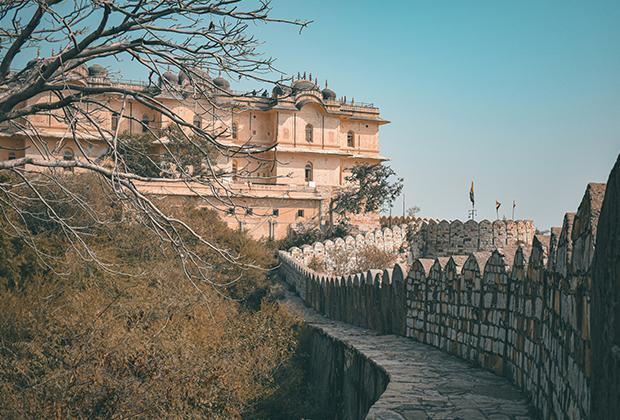
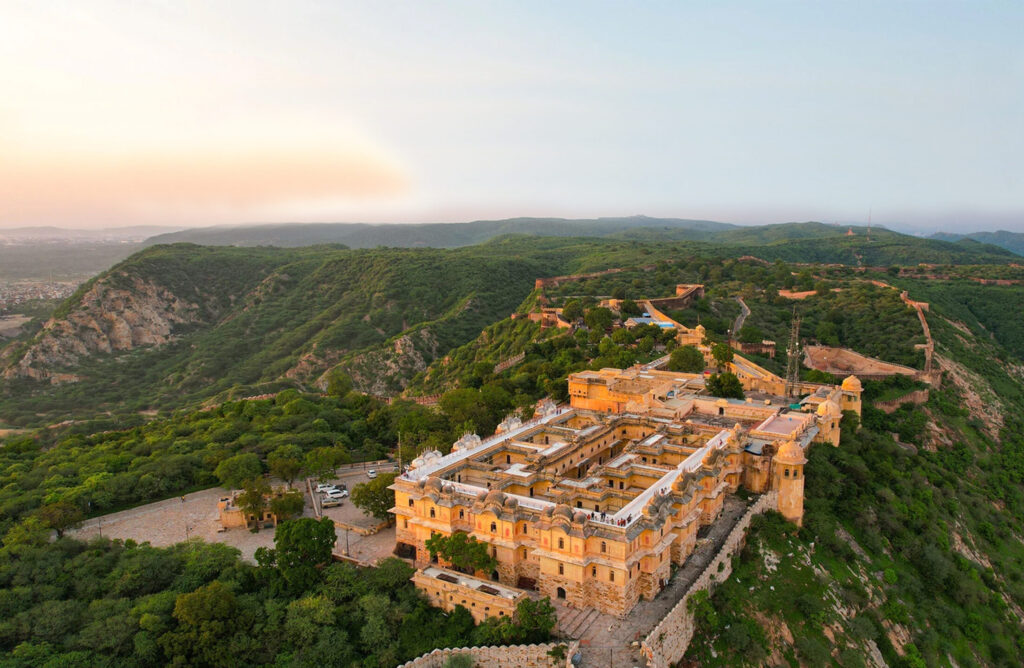
Nahargarh fort was built by Maharaja Sawai Jai Singh II in the year 1734 for the sake of defense of Jaipur city. In the early 18th century, the Mughal dynasty was at their decline while power of Marathas was expanding. Looking over these conditions, Maharaja Sawai Jai Singh II erected this fort on about 700 feet high hill in the north of Jaipur city. Originally this fort was named as Sudarshangarh, but later on it was given the name Nahargarh, dedicating to Nahar Singh Bhomia, a local hero, whose shrine is situated in this premises. Madhvendra Bhawan forming fortification connects it to Jaigarh fort. The fort comprises of spacious Tanka and two splendid step wells for water management, barracks for army personnel’s arsenal to house armory, ramps to carry cannons and.
Earlier palaces inside the fort were constructed by successive rulers of Jaipur in different phases. Diwan-e-aam, treasury and rest rooms for soldiers were built by Maharaja Sawai Jai Singh II (1699-1743), Hawa Mandir by Maharaja Ram Singh II (1835-1880) and Shri Madhvendra Bhawan by Maharaja Sawai Madho Singh II (1880-1922).
The defence mechanism of Nahargarh was very strong. Though the fort never faced any attack during the course of its history, it witnessed some major historical events. Firstly in the reign of Maharaja Sawai Pratap Singh (1779-1803), Nawab Wazir Ali of Awadh was given shelter here. Subsequently during the reign of Maharaja Sawai Jagat Singh (1803-1818), the feudatory princes (samntas) kept Raskapoor, a prisoner in this fort after being frustrated with her interference in the royal matters. Who was lover of Maharaja Jagat Singh. The finance minister of the state, Sanghi Jhutharam was also imprisoned here during the reign of Maharaja Sawai Jai Singh III (1819-1835). During Indian mutiny of 1857, the Europeans of the region, including the British Resident’s wife, were moved to Nahargarh fort by Maharaja Sawai Ram Singh, for their protection. Entrance of common men in the fort was prohibited but special persons were allowed blindfolded.
The treasure of the state was kept here since the regime of Maharaja Sawai Jai Singh II.
In this Fort the water storage and its management system is unique and rare. A huge water reservoir (Tanka) and two step wells were constructed here to collect the rain water coming through the channels made in the hills. Small chambers were built between the channels to filter the impurities and to make the water clean. A special water purification system is set up near the step well to purify the rain water in multiple phase. These splendid step well are great attraction for tourists because of its magnificent architecture and remarkable systematic planning.
The main palace situated in the fort is known as Shri Madhvendra Bhawan. This double storeyed palace is divided in ten apartments, out of which one was used by the King himself and other nine were built for his concubines. The king’s apartment is connected to all the nine apartments through a corridor, known as “Raja ka Galiyara”. Through this corridor the king can enter any of nine apartments.
Likewise all the apartments were also connected to each other. These apartments are named as Suraj prakash, Chand prakash, Khushal prakash, Anand prakash, Jawahar prakash, Laxmi prakash, Lalit prakash, Basant prakash and Ratan prakash. Each apartment comprises of bed room, store room, verandah, courtyard, kitchen and toilet. There is a fire altar in the bed room for winters. The whole palace is adorned with excellent aarish work and fresco paintings. Mainly green, brown, red, blue and yellow colours were used to decorate the painting. Beautiful ventilators are decorated with coloured glasses. This palace is a splendid example of Indo-Western architecture.

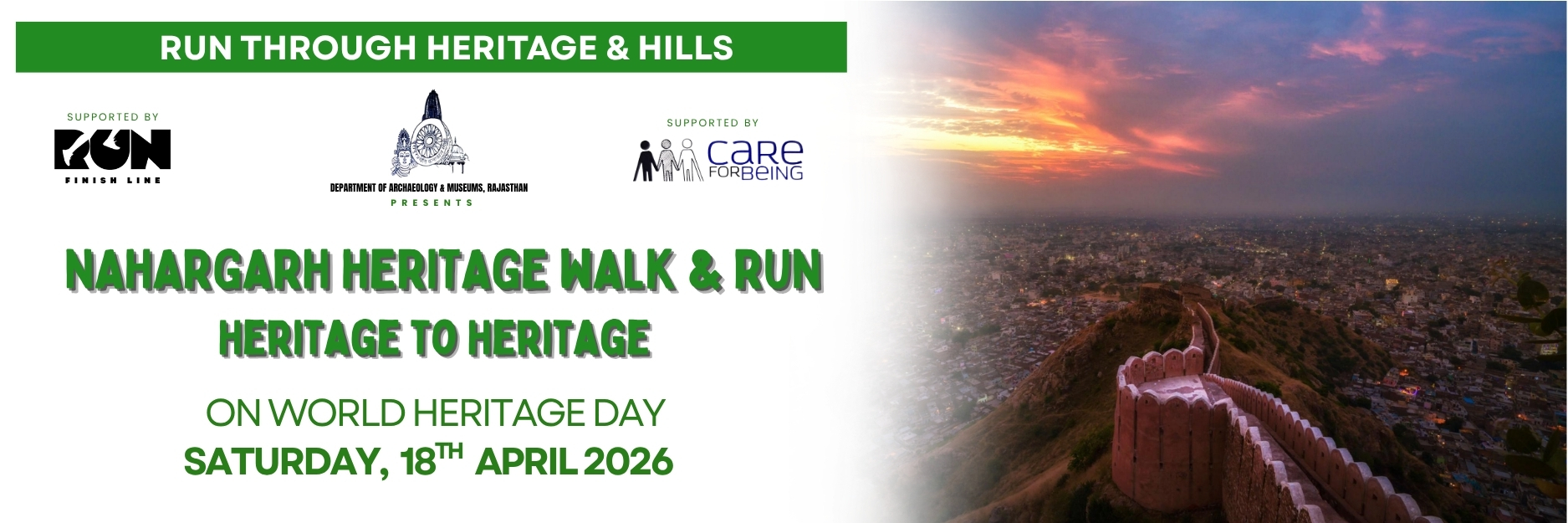




 Date: Saturday, 18Th April 2026
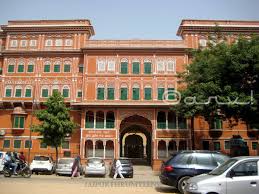
 Location: Museum of Legacies, Kishanpole Market, Jaipur
 Reporting Time: 05:00 AM
 Flag-Off Time: 06:00 AM